
Distribution businesses running cash vans (van sales) know the channel's strength: sell, deliver and collect in one trip. Its biggest weakness is that goods are outside the warehouse all day — without a system that genuinely controls on-van stock, good-looking sales can vanish into goods you can't trace. This article sums up what a workable cash van system must include.
What is a cash van?
A cash van is a sales team that carries goods on the vehicle and sells directly at the customer's storefront — billing, delivering and collecting (cash or credit) in one stop. It's popular for consumer goods, beverages and items corner stores restock often. For the detailed difference between van sales and pre-sales, see our What is van sales article — this one focuses on the system.
Why notebooks and Excel never balance
- Morning loading is written on paper, then keyed in after a full day of selling — the numbers never match reality.
- End-of-day clearing is van by van; drivers get back late, so admins stay late, every day.
- Each store gets a different price, held in the rep's memory — swap the rep and the prices drift.
- Credit is extended on-site without seeing old balances; by the time you notice, several bills are hard to collect.
- A few cases lost per trip looks minor, but across every van for a month it's profit quietly disappearing.
What a good cash van system must include
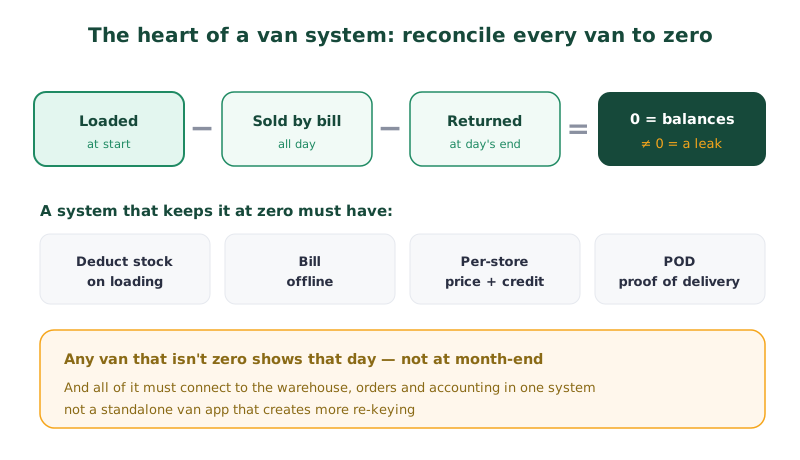
- Loading = real stock deduction — goods loaded move from the warehouse to that van's stock instantly, so you see exactly what each van holds.
- Offline billing — real routes always have dead zones; bill, record deliveries and take payment with no internet, syncing back automatically.
- Per-store pricing + credit check before selling — the system pulls that store's price and shows the outstanding balance and credit limit before billing; no relying on memory.
- Proof of delivery (POD) — photo or signature in the app ends "short delivery / never received" disputes with evidence.
- End-of-day returns + automatic reconciliation — leftovers return to the warehouse and the system compares loaded − sold − returned instantly; a short van is visible that day, not at month-end.
- Per-van, per-route reports — see which van and which route earns or loses, to plan routes and promotions.
Don't shop for a standalone "van app"
An app that controls only the van but doesn't connect to the warehouse and accounting creates yet another data island — on-van stock disagrees with the warehouse, on-site bills get re-keyed into accounting, and tax invoices are chased afterward. A cash van system that truly pays off should be part of a Distribution Management System (DMS) where warehouse stock, on-van stock, orders from every channel and accounting documents live on one set of data.
Where to start (you can do this tomorrow)
No system needed to start hunting leaks — use the same equation as the diagram:
- Count stock at loading on every van each morning, recorded as a starting number — with no starting figure you can't reconcile.
- At day's end compute loaded − sold − returned per van; watch any van that isn't zero to find where it leaks.
- Time how long it takes to clear one van today as a baseline to measure whether a new system actually helps.
- Give the driver a per-store price and balance sheet to cut price drift and ballooning credit starting today.
Summary
A good cash van system makes on-van goods stock the system genuinely deducts — from loading to return — bills offline, pulls each store's price and credit automatically, captures proof of delivery, and reconciles automatically at day's end. And it should connect to the warehouse, orders and accounting in one system, not a standalone app that creates more re-keying. Start tomorrow by counting at loading and reconciling three numbers at day's end. See how FMS covers all of this in the van sales feature.