

This month's sales beat target, but when the supplier bill comes due the bank balance can't cover it — because most of that revenue is still accounts receivable, sitting in bills you sold on credit. This shop asks for another week; that one says they'll pay when the owner is back. You made the sale, but the cash is stuck out in the market, and you can't collect fast enough to cover your own payment cycle. This article walks through how to control credit and collect wholesale debt systematically — from who gets how much credit, to spotting who's long overdue, to pacing collections so cash flow doesn't stall.
Strong sales, so why isn't there enough cash?
For many wholesalers the problem isn't selling — it's selling but not collecting in time. The profit sits on paper, not in the bank. Every bill on credit is money you fronted to the customer. The number to watch is your average collection period (how many days from sale to getting paid). The longer it runs, the more fresh cash you need to fund the next buying round, replacing money still tied up in the market.
Signs that credit control is slipping usually look like this:
- Extending the same credit to every shop, without separating who pays on time from who chronically runs late.
- Not being able to answer right away how much customers owe you in total today, and who is overdue.
- Issuing a new bill to a shop that still owes on an old one, unaware the old debt isn't cleared.
- Chasing payment only when it crosses your mind — no fixed rhythm — so some shops go unchased for a month.
Set credit terms differently by customer group
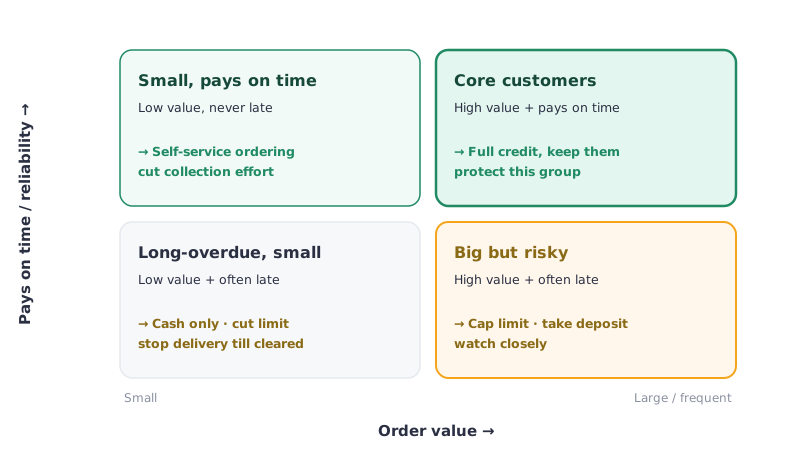
A credit term is the agreement on how many days until payment — say 7 / 15 / 30 days. The common mistake is giving everyone the same, when the risk varies wildly. The right move is to set credit and a credit limit by default risk × order value (to segment customers more finely, see how to segment wholesale customers):
- Small / corner shops that pay on time — small per-bill value, low risk. Give short credit or sell cash, and open self-service reordering to cut the legwork of chasing small amounts.
- Big wholesalers (yi pua) who bargain for long credit — your core volume, yes, but set a clear ceiling limit; once they exceed it they must clear before ordering more. Don't let a single balance balloon beyond what you can carry.
- New shops / nightlife venues — the riskiest, with no track record and quick open-and-close. Sell cash or take a deposit at first, then ease into credit only once enough on-time payment history builds up.
- Government / corporate — buy via PO with the longest credit (30–60 day terms) but low default risk. Prepare complete, correct documents and tax invoices, and plan cash flow because payment takes a while.
Read overdue receivables by age (AR aging)
Looking at the "total owed" alone isn't enough — you need to see how long each balance has been outstanding, because the older the debt, the harder to collect and the higher the loss risk. AR aging sorts what's owed into buckets by days past due, so you see instantly where the cash is stuck and with whom, then focus on the bucket about to age before it turns into a bad debt:
- Not yet due — normal; just send a statement reminder ahead of the due date.
- 1–30 days overdue — a polite call, confirm a payment date; no need to worry much yet.
- 31–60 days overdue — chase more closely and pause extending further credit until they pay.
- 60–90+ days overdue — push to negotiate, set a payment plan, and switch to cash-only, since the chance of recovery drops fast past 90 days.
Bill and collect on a rhythm, not on a whim
Most Thai wholesale businesses run on a cycle of issuing the bill then scheduling a cheque-collection round. The problem: if you chase "when it crosses your mind," some shops slip a month with no one following up. What works is giving collection a fixed rhythm like your delivery rounds — remind before the due date, bill on schedule, and chase the moment it's overdue rather than waiting for the customer to remember. Whoever goes out to collect should carry the latest per-shop balance, not an old sheet whose numbers no longer match reality.
Where to start (you can do this tomorrow with data you already have)
No need to wait for a big system — start with the billing data your store already has:
- Pull every outstanding balance, sorted by age (not yet due / 1–30 / 31–60 / 60+ days) and see where the cash is stuck.
- Tag every customer with a credit term + limit by risk × order value, kept in the customer record.
- List overdue debtors, oldest/largest first, and call them all within this week.
- Set one rule for the whole team — a shop over its limit or past due must clear before a new bill is issued.
- Schedule regular billing-and-collection rounds by zone/route, not on a whim.
Where a system helps
The first aging analysis can be done in Excel, but the spot that always fails is "at billing time on-site," because the rep or biller doesn't know how much this shop already owes and releases more goods on top of old debt. A field sales system that checks the credit limit and shows the outstanding balance before billing is what stops balances ballooning right at the point of sale. For documents and reconciliation, a system that issues tax invoices, credit notes and statements in one set, with reports your accounting can post from keeps the billing cycle and the overdue picture matching real sales on every bill. To close the month faster too, read how to speed up month-end closing.
Summary
Receivables you can't control are why "sales are strong but there's never enough cash." The fix isn't chasing harder — it's setting credit terms and limits by risk × order value, reading receivables by age to collect the bucket about to go bad first, and pacing billing and collection on a fixed rhythm. Start tomorrow with the billing data you have, then let a system check credit and surface the balance accurately on every bill. When cash flow turns over in time, growing sales become real cash in hand — not numbers stuck out in the market.