

Many wholesale owners look at the month's total sales and feel reassured — the number grows every year. But ask "which stores actually make us money, and which just burn time and trucks?" and they can't answer, because every customer has been treated the same — discounting for stores that didn't need it, extending credit to the riskiest ones, and driving a few cases out to far-flung shops every week. This article walks through segmenting wholesale customers the way a consultant actually would, so you know where to put your effort and how to grow the right stores.
Why the "total" misleads you
Total sales only tell you how much money came in — not how much profit is left after the cost of goods, delivery cost and tied-up credit. The 80/20 rule says roughly 20% of customers usually deliver more than half your profit, while many stores look good on revenue but, once real costs come off, leave a thin margin or even a loss — like a shop that orders small but wants frequent far deliveries, or one on wholesale prices that pays late. The problem: while you see customers as one block, you never see who's who, and you keep aiming discounts and promos at the wrong stores.
Axis 1 — by store type (who buys what, pays how, how risky)
The easiest axis to grasp is store type, because each behaves differently in buying, payment and risk. Tag every customer with a group, then look at the full picture — what they buy, how they pay, their margin/risk, and what to do:
- Retail / corner stores — small but varied orders, cash or short credit; decent per-bill margin but high delivery cost per bill, low credit risk · Push fuller orders per round, consolidate delivery trips, and open self-service reordering to cut order-taking cost.
- Sub-wholesalers (sa pua) — buy to redistribute, order regularly, want wholesale prices and volume discounts; thin per-unit margin propped up by volume; the risk is they undercut each other with your price · Lock clear tiered prices and stop price leakage.
- Large wholesalers (yi pua) — big lots, hard bargaining, long credit; your core volume but low per-unit profit and high dependence — losing one dents revenue immediately · Bind them with service and reliability, not price alone, and don't let one account take too large a share.
- Nightlife — pubs / bars / liquor shops — sales swing hard by season and festival (year-end and Songkran spike, low season vanishes), odd delivery windows, last-minute evening orders, the highest credit risk because shops open and close fast, and prices must never leak because this group talks fast · Control credit especially tightly, cut limits or take deposits in risky periods, and price them separately from other groups.
- Restaurants / hotels (HORECA) — order by menu and their own customers' demand, want on-time delivery and consistent quality more than the lowest price, medium credit · Focus on punctuality and no stockouts, cross-sell items used together; margins are usually better than the resale groups.
- Government / corporate — buy via PO with paperwork steps and the longest credit (30–60 day terms) but low default risk · Prepare complete, correct documents and tax invoices, and plan cash flow because payment takes a while.
Axis 2 — by buying behavior (RFM: last order · how often · how much)
Store type tells you who a customer "is," but not whether they're "growing or slipping away." The second axis reads buying behavior with the RFM frame, which is really three simple questions per customer:
- When did they last order (Recency) — a store that used to order weekly and has gone quiet for a month is a signal you're about to lose them to a rival; win them back before it's too late.
- How often do they order (Frequency) — frequency shows attachment; a steady orderer is a stable base, while one who orders rarely deserves a look at why they've drifted.
- How much per order (Monetary) — average bill size shows how much of their wallet you capture; a store that orders often but small is probably still buying plenty from others — a gap to grow into.
Combine the three and the picture appears instantly: a store that's frequent + large + recent is a core customer to protect, while one that used to order big but has gone quiet is your first win-back target — they already know your goods, so winning them back is far easier and cheaper than finding a new shop.
Axis 3 — by true profit (cost-to-serve: delivery cost per bill)
The first two axes still aren't complete. Without subtracting cost-to-serve, some high-revenue stores turn out, once the invisible costs go in, to leave barely any profit or a loss. Those costs include:
- Delivery cost per bill — a far store ordering small but often costs far more in fuel and truck time per case than one ordering large in a single go.
- Frequent small drops — three small trips a week cost more than one combined trip, even at the same total revenue.
- Tied-up credit — money sitting in a long-unpaid bill is a financing cost you carry for them; the longer it sits, the more it eats profit.
- Returns / claims / breakage — some stores return or claim so often it quietly eats the margin you should have earned.
Once it's all subtracted, the "top-revenue" store may not be the "top-profit" store — and that's where you have to be willing to fix terms, like setting a minimum order per delivery or cutting delivery frequency, rather than piling on more discount.
Price fences — stop price leakage across groups
Once you segment and set different prices, the next problem is price leakage across groups — the price you gave a sub-wholesaler surfacing in a retail shop's hands until you undercut yourself. A price fence is the condition that lets each group keep its own price without easily crossing over — tie price to customer group and purchase volume, not to per-person haggling you can no longer remember. When prices follow set rules rather than a salesperson's memory, they stay stable and much harder to leak — especially for the nightlife group that talks prices fast and where leakage is fatal.
Where to start (you can do this tomorrow with data you already have)
No need to wait for a big system — start with the sales data your store already has:
- Pull each customer's purchases over 6–12 months, sort high to low, and see what share the top 20% of stores produce — your real 80/20, instantly.
- Tag every customer's store type (corner store / sub-wholesaler / large wholesaler / nightlife / HORECA / government) and keep it in the customer record.
- Note the 3 RFM numbers per customer — last order date, frequency and average bill size — as columns in one file.
- Roughly estimate delivery cost per bill (number of trips × distance/truck time) and subtract it from gross margin to see who actually leaves little profit.
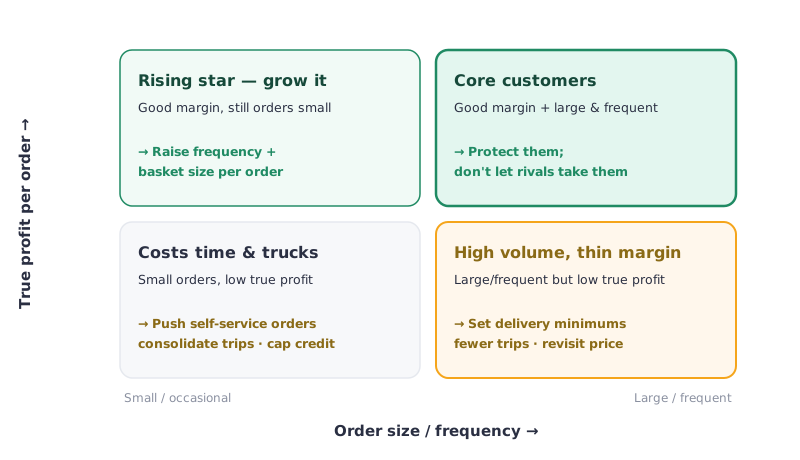
- Plot stores onto the 2×2 (true profit × size/frequency) and make one of four calls: protect · grow · fix terms · cap cost/credit, as in the matrix above.
Where a system helps
The first segmentation can be done in Excel, but to make it "take effect on every real bill" you need the system to enforce it. A field sales system that pulls per-segment pricing and checks credit before billing is what makes each group's price and the price fence actually happen on-site, instead of slipping away with people's memory. Growing sales and winning customers back is supported by an order capture system that lets regular customers reorder themselves and unifies every channel, so you can see which stores are drifting and nudge them back individually. To understand the wholesale customer structure more deeply, read who yi pua and sa pua are in the chain, and if you're choosing a system to support all of this, see the checklist for choosing a DMS.
Summary
No two wholesale customers are equal. Segmentation that actually works looks at three axes at once — store type (who they are) · RFM (growing or slipping) · cost-to-serve (true profit) — then combines them into a 2×2 to decide whether to protect, grow, fix terms, or cap cost for each store. Start tomorrow with the sales data you already have, then let a system enforce per-segment pricing and credit control on every bill. Do that, and growing revenue comes with genuinely growing profit — not pretty numbers whose margin quietly disappears.