
When a wholesale or distribution business starts looking for a system to run the back office, one of the first questions is: "ERP or DMS?" Both sound big and similar, but they're designed for different work — and choosing wrong up front costs you both money and a year of time. This article explains the difference simply, plus how to check where your business should start.
What is an ERP?
ERP (Enterprise Resource Planning) is a central system that unifies the whole organization — accounting, finance, manufacturing, HR, purchasing and inventory. Its strength is "broad coverage," giving a company-wide view in one place. It suits organizations with many departments that must share data.
But breadth comes at a price — high investment, months-to-a-year implementation, complex customization, an IT team to maintain it, and crucially for wholesale, the sales modules usually aren't built for real on-the-ground work — like billing from a van with no signal, or complex per-segment pricing.
What is a DMS?
DMS (Distribution Management System) is focused specifically on "distribution" — capturing orders from many channels, controlling multi-warehouse and on-van stock, managing vans and field reps (pre-sales), setting per-segment pricing, issuing tax invoices and delivering. Its strength is being "deep and on-target" for what distribution businesses face daily.
Because it's narrower, a DMS usually starts faster, costs less to reach, and its screens are built for people on the ground — a rep billing from a phone in a few taps, no week-long training.
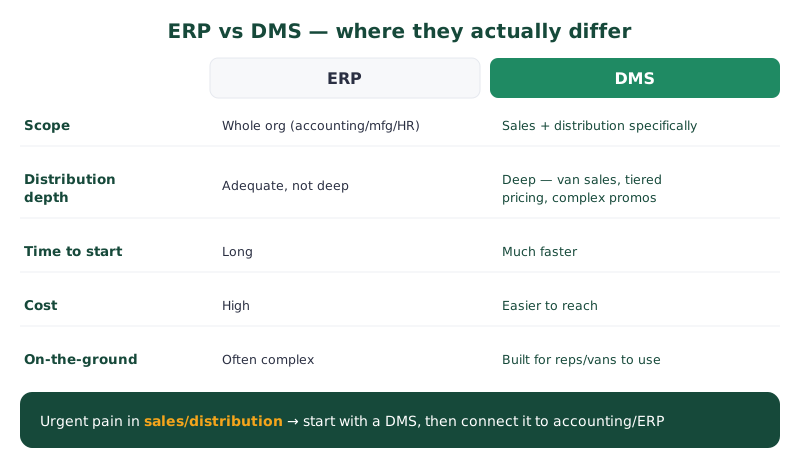
A clear comparison across 5 axes
- Scope: ERP = whole organization (accounting/manufacturing/HR/purchasing) · DMS = sales and distribution specifically
- Distribution depth: ERP = adequate but not deep · DMS = deep — van sales, multi-tier pricing, complex promotions, multiple units
- Time to start: ERP = long (months to a year) · DMS = much faster
- Cost: ERP = high, needs a team to run · DMS = easier to reach
- On-the-ground usability: ERP = often complex, long to train · DMS = built for reps/vans, minimal taps
So which should a distribution business choose?
It depends on where it "hurts most." Weigh these three angles:
- Where the urgent pain is — scattered orders, mismatched stock, missing van stock, slow closing → that's what a DMS solves on-target and starts fast. Manufacturing cost or consolidating accounts across group companies → that's ERP territory.
- Your organization's size and complexity — if the core work is buy-sell-distribute, a DMS is enough; if you run your own factory or multiple business units consolidating financials, you likely need an ERP at the core.
- Existing systems — if you already have accounting software you're happy with, there's no need to scrap it for a whole new ERP; adding a DMS for sales and feeding its documents and reports to your accounting is far more worthwhile.
You don't have to choose one or the other
In practice, many businesses don't choose one or the other. A good DMS can produce tax invoices and sales–tax reports for the accounting software or ERP you already use to post from, keeping on-the-ground sales fluid in the DMS while the financial overview stays in your existing accounting — getting both on-the-ground depth and accounting completeness, without a big ERP investment up front.
Where to start (you can do this tomorrow)
Before talking to any vendor, diagnose yourself with these questions — the answers tell you whether to start with a DMS or an ERP:
- What ate the most time last month — if it's pulling bills together, chasing stock, clearing vans, that's DMS work.
- Which channels do orders come from, and where do they fall through — write it out and the gaps a system must plug become visible.
- How does your accounting take in data today — if it can post from tax invoices and sales reports, the DMS-plus-existing-accounting path is already open.
- List one real day of operations (load van, bill, issue invoice, view end-of-day report) and run it on systems you're considering — wherever it sticks is where it sticks every day after.
Summary
An ERP covers the whole organization but is big and expensive; a DMS is deep and on-target for distribution and starts faster. For wholesalers and distributors whose problems are in back-office sales, starting with a DMS and feeding its documents and reports to accounting is usually the most worthwhile, fastest-to-results path. See what a DMS covers in all FMS features, or continue with the checklist for choosing a DMS.